CONTROL PANELS - TRADITIONAL/ANALOGUE & DIGITAL
Control panels are generally associated with traditional analogue DC track
control. The requirement to break the layout down into track sections with each
section requiring a switch together with turnout motor control switches and
accessory switches makes a control panel necessary. The hands on operation of
the layout particularly turnout motor control is very popular and is becoming
more popular on digital layouts. It is possible to integrate analogue switch
control with advanced digital accessory decoders e.g. Team Digital SMD82.
Digital control panels are briefly featured at the bottom of this page. Please
see the DCC digital section for more information. Panels can be manufactured to most shapes and sizes
and can include rack mounted systems for private and commercial installations as shown below featuring CNC
drilling with screen printed panels and draws to contain control apparatus.

ANALOGUE CONTROL PANELS
The control panel is usually the most used feature of a model railway. Its
design, construction and operation must therefore be given careful consideration
to ensure the finished product will operate the layout in the required manner.
The normal requirement of panel is to control some, or all of the three primary
control features on a layout - track power, turnout motors and signals. It may
also be convenient to have other operating features controlled from the panel,
for example turntables, sound effects, and lighting.
Control panels can be of two specific types:
 | Schematic Control Panels |
| Non-Schematic Control Panels |
Schematic Control Panels
Schematic control panels are by far the most popular and easiest to use as the
necessary switches are located where appropriate on a track diagram. The track
diagram is drawn to a size that allows sufficient space for the correct location
of switches rather than to scale. It is therefore comparable to the diagrams
seen in signal boxes. Schematic panels are easier to operate, especially for
those unfamiliar with the layout as the panel switches relate to the layout
itself.

Most layouts do not require such a large control panel as that
shown above. For smaller layouts or 'local' control panels on a large layout it
is not usually necessary to manufacture a bespoke panel with an aluminium or
Perspex screen. Often we can use a standard electronic apparatus case to
manufacture a small panel with either an aluminium or ABS plastic screen as
shown below.
 |

|
Non-Schematic Control Panels
Generally used on smaller layouts, the panel consists of rows of switches to
control the functions required. As no track diagram is present, either notation
or memory is required to remember the function of each switch. A very popular
option is to use the lever style switches manufactured by Peco and Hornby. A
variety of switch types are available, usually with a different coloured housing
to allow them to be identified easily. For example the black Hornby switch is a
momentary (passing contact switch) for turnout motor control, the green switch
is on-off and the yellow switch on-on.
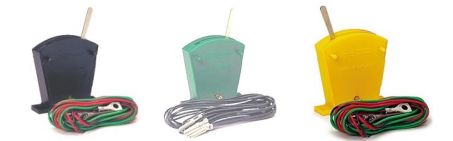
Peco manufacture their switches to fit into a lever frame
holding six switches. The switches are again colour coded depending upon the
switch type. The black switch for turnout motors are also available with
alternative coloured levers.

Professional Layout Services are very experienced in the design and
construction of control panels to customer requirements. From a supplied track
plan we can design your panel screen for schematic screens, if required produce the panel from a variety of materials available, and install the panel onto your
layout. Alternatively we can design and or construct the panel producing an
internal connection diagram for the client to connect the panel to the layout.
We are also happy to wire your layout using lever switches as shown above. This
is particularly popular on DCC layouts where the track control is DCC digital
but there is a wish to have turnout control by conventional methods similar to a
signal box. These panels can be fully digital - please see the DCC Digital
section below.

Control Panel Under Construction:
|
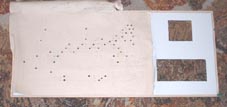
Photo 1. Panel drawing attached to perspex screen and
drilled for switches etc.
|
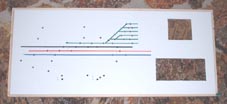
Photo 2. Lining tape is added to build the schematic
diagram.
|
|

Photo 3. The schematic diagram ready for
switches/controllers.
|
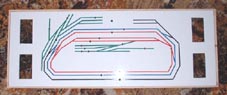
Photo 4. Another panel ready for hardware installation.
|
|

Photo 5. The panel equipped with Gaugemaster controllers.
Toggle switches have been installed for track section control with
turnout motors operated by pen probe and studs.
|

Photo 6. The internal wiring of the panel.
|
CONTROL PANEL FEATURES
Control panels are unique to individual requirements. The following list shows
the standard features normally requested on control panels, together with those
frequently requested:

Standard Features:
| Panel mounted controllers and transformers. For convenience the
controller can be located within the panel screen improving the appearance
of the panel. Transformers are usually located remote from the panel to
allow them to cool. Where hand held controllers are requested, din plugs can
be fitted to the panel to allow the units to be removed as required. If the
client already posses cased controllers i.e. those with the transformer
contained within, connections to these units can be made keeping them
external from the panel. For safety reasons in compliance with current
legislation, PLS only supply and use factory manufactured and cased
transformers to power panel mounted and hand held controllers. |
| Track section switches. These are usually double throw switches
with a centre off position, as layouts usually require two controllers to
operate them. Control panels can however be manufactured to switch as many
controllers as required using rotary switches. All section switches are
usually wired to allow any controller access to any section of track, thus
allowing locomotives to move across the layout without the need to change
controllers. |
| End of track push to make switches (PTM). A switch that is always
off until depressed (remaining on while depressed only - non latching). Of
particular use on a small isolated section at the end of terminal rail to
automatically stop a locomotive at the head of a train as it approaches the
end of the line. The locomotive can be moved up to the end of the line by
depressing the switch, or left isolated at the end whilst another locomotive
can be controlled on the track section. |
| Turnout control switches and capacitor discharge units (CDU).
Electric turnout motors are common place on many layouts. Their location on
a schematic panel makes operation simple as the control switch can be
located on its position on the diagram. Switches for solenoid type turnout
motors usually require a 16 - 24v AC supply, and must have a momentary
output i.e. non latching to prevent damage to the solenoid coil. A capacitor
discharge unit is usually fitted to panels controlling solenoid motors as
this increases the power allowing more than one motor to be controlled from
one switch, and protects the solenoid from damage. Motor driven slow action
turnout motors require a latching feed and normally a 12v DC supply. These
are usually controlled via a DPDT switch. |
| Signal control. Sometimes interlocked with turnout operation
signals can be controlled using switches located on the control panel. The
switch type depends on the signal. |

Additional features
| Electronic track cleaners. A must on most layouts to help maintain
locomotive performance. An electronic cleaner (requiring a 16v AC supply) is
dedicated to each controller cleaning the rail and wheel at their interface.
The cleaner only works when the locomotive is working. |
| Turnout status indicators. A popular additional feature on control
panels. Using an accessory switch either supplied with or added to a turnout
motor, the position of the turnout motor can be represented on the panel
using an indicator, usually an LED. Of particular use on larger layouts, or
on layouts where areas are not visible. |
| Diode matrix. Used to operate multiple turnout motors in route
selection using just one switch. A simple matrix is useful for controlling
slips and three way turnouts as the switch or stud position does not
represent the route available. This can be used to replace reverse logic on
slips and allow actual route selection. |
| Track detection. On larger layouts or hidden sections the location
of a moving or stationary train can be useful. Using reed switches, light
dependent resistors or infrared detectors; a signal can be sent to an
indicator on the schematic plan to show the location of a train. |
| Station stops, shuttles etc. Simple automation of areas of the
layout can provide an interesting feature leaving the operator to
concentrate on other aspects of the layout. |
| Sound generators. Bring the layout to life with simple sound
generators. Linked to the output of each controller, the sound unit
increases its beat automatically with the speed of the locomotive |
| Accessory control. Include switches on the panel for level
crossings, turntables, lights etc. |
| Closed circuit TV. Not usually contained within a panel but now a
regular feature (with the reduced cost of cameras and small TV's) CCTV
offers an alternative to track detection whilst allows you to view unseen
areas of your layout. |

DIGITAL CONTROL PANELS
It is possible to combine an analogue style control panel with DCC digital. Why
would you want to do this? Many model railway enthusiasts enjoy the manual input
of switching turnouts or having the ability to detect the presence of a train on
hidden areas of the layout particularly fiddle yards. A schematic panel can be
useful to locate turnout switches or display indicators for track status. Traditional
lever switches e.g. Peco or Hornby can also be used
if a lever frame is preferred. More advanced DCC accessory decoders have input
channels available to allow the input from a switch to change the turnout via
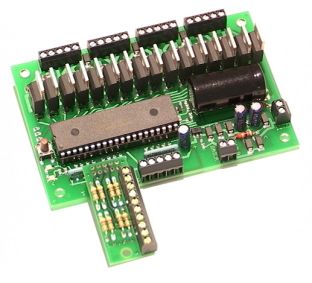
the accessory decoder. The device we use for this purpose is the Team
Digital SMD82 switch machine driver capable of operating both solenoid or slow
action Tortoise style turnout motors. This high quality device has a 10 pin IDC
input designed for primary inputs via a header or the Team Digital TSA (Terminal
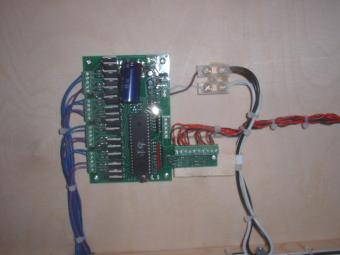
Strip Adaptor) shown below on the left. A wired Team Digital TSA is shown to the
right with the input wires from Hornby lever switches.
 |
 |
The use of primary inputs does not prevent the operation of the
turnout via the DCC handset or the use of Macros/Route settings. It therefore
adds yet another dimension to the versatility of DCC control and can lead to an
automated layout.
DCC track detection is much easier than analogue and does not
need to result in a reduction of block power. Whilst analogue detectors can be
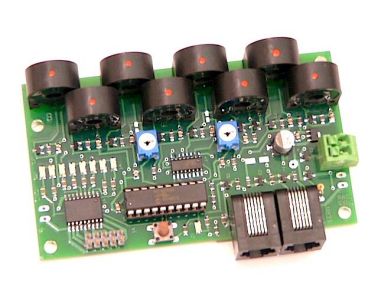
used DCC detectors are very simple to install as shown in the wiring diagram below for the
Team Digital BlocD8. Each isolated block needing detection simply requires one
block wire passing through the detector. Status is shown on the unit or external
indicators can be added to a schematic control panel.
|