

| | BASEBOARDS & BENCHWORK (FRAMES)
After layout design, baseboards are probably the most important feature of
any model railway. They are the foundation upon which the track and scenery
depend. Without a rigid, flat base the track will become uneven causing poor
running and possibly derailments and de-coupling. Unfortunately most railway
modellers do not give sufficient consideration to the design and construction of
their baseboards.
BENCHWORK or FRAMES
Baseboards are standard boards consisting of a track surface with supporting
frame. These are the standard boards we supply to most clients. We also
manufacture benchwork or frames for those clients wishing to purchase the
baseboard frames and or legs to finish the layout frames in their own way but
saving much time and effort. Please visit our Benchwork Section

Example of a standard baseboard with braced legs
(also features corner protectors and edge tape).
|

Example of benchwork or frames
|
BASEBOARDS
In an ideal world baseboard design should commence once the track plan has
been finalised. The track plan defines the layout shape, the type of scenery,
and the location of critical features; for example turnouts where electric
motors may be required beneath the baseboard without obstruction from the
structural joinery. Computer aided layout design (CAD) is used by Professional
Layout Services producing initially the track plan from the customers dimensions
and requirements, before designing the structural joinery based around the track
plan. Click here to visit layout design.
Boards do not have to be rectangles with tack running parallel to the baseboard
edges. Try and vary your ideas to avoid parallel lines, alter the baseboard
shape to fit the track. This can make a layout much more visually interesting.
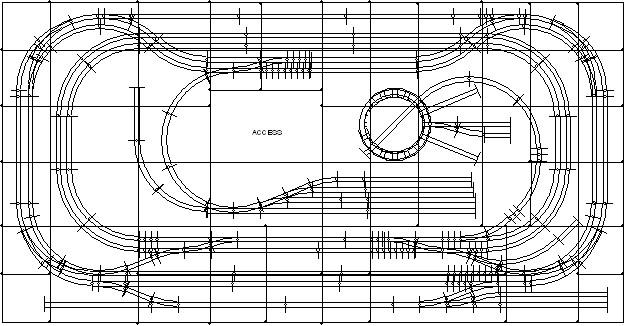
The advantage of using a good quality model railway CAD package like Winrail
is that once the track design is complete, it is simple to move on to the design
of the boards from the CAD track plan. A simple illustration of this is shown
below. The X-Y grid on the CAD program allows the user to locate the exact
location of any position on the layout. With a simple layout it is easy to
design the location of the under board frame work to avoid fouling turnout
motors. If a standard 12" frame had been used on the plan below, several
turnouts would have been located on or close to the structural frame making
under board motor location difficult. Careful design of the frame makes the
manufacture of the baseboards simple and no obstructions when it comes to laying
the track and fitting turnout motors.

On larger layouts this can be further used
to decide upon the size and shape of baseboard units before designing their
structural timber work.
Materials
Over the years many materials have been tried in model railway baseboard
construction. Recently construction foam and fibre boards have seen use
particularly in America, however we prefer to use traditional timber. When
manufacturing baseboards we take into consideration how they are going to be
used with reference to size, shape and weight. It is also very important to
consider access to the layout room - what is the route like to the railway room,
door size, access to a loft, loft height, shape of stairs - these may all be
critical when selecting board size and shape. The following is a guide to
surface materials most frequently used or requested:
 | Plywood - our preferred
material for baseboard surfaces. It is strong and durable and will withstand
changes in environmental conditions that other materials will not. When
using a timber outside exterior grade plywood should be the chosen material,
when sealed correctly it will outlast most products. Two types of plywood
are generally available:- Far Eastern Plywood (FE Ply) - Generally the
plywood sold by the DIY 'sheds'. Depending on thickness it is usually
composed from a central thick core laminate with two outer thinner
laminates and a finish laminate on the outer surfaces. Can be a white or
red finish. This is a low cost plywood but is better than some
materials. Some reports of woodworm in this grade of plywood.
- Birch
Plywood - If you wish to use the best then Birch Plywood is probably it!
Composed of roughly equal thickness laminates throughout this material
is extremely tough and durable. Track pins may need pre-drilling but the
extra effort is worthwhile as birch plywood will offer many years of
trouble free use. Usually a natural white timber colour. This is not
cheap, but if it was good enough for the RAF, its good enough for a
model railway! Ideal for making open frame and airframe boards with
little softwood required.
|
| Sundeala - Often recommended
in publications as Sundeala is light and easily takes a track pin but
proceed with caution. This high cost fibre board is best used for notice
boards and that's where it should stay - on the wall. Sundeala is prone to
swelling by absorbing external moisture, sagging and also curling at the
edges. Our advice is use only for table top single board layouts where
weight is paramount. Do not exceed 12" centres for a supporting frame
under a Sundeala board as it is likely to sag. Not suitable for use in
attics, sheds or garages where environmental conditions may change. |
| MDF
(Medium Density Fibreboard) - This particle board originated out of a need
for a 'timber' constructional material with no grain that machines and
finishes to a high standard - hence its use in furniture, particularly
kitchen units. MDF is quite hard to fix a pin but for many it is a neat
material although a little heavy. Do not use for baseboard frames in open
frame or airframe construction, or where high strength is required. Not
recommended for use below 12mm in thickness. |
| Chipboard - ideal for
train set boards as low cost. Not considered by the serious enthusiast. |
Not included in this section are
items classed as Specialist Joinery e.g. Spirals and
Traversers, Backscene Boards, Diorama Boards, Folding Baseboards, Control Panel
Draws and Lifting Sections. Click here to visit Specialist Joinery.
Professional Layout Services will manufacture
baseboards according to customer requirements. The most popular types of
construction include:
| Traditional. The most popular
construction method best suited to layout with a high track density. Simply
constructed from a sheet material top surface (usually plywood for the
enthusiast, and chipboard or MDF for those on a more restricted budget or
children) with a soft wood jointed frame on the underside. These baseboards
can be produced to most sizes and shapes. Click
here to view our price list for standard size traditional baseboards.
|
| Open Frame. This method of
construction is often preferred by the railway modeller that has evolved
their design concept to include gradients and a greater proportion of
scenery than is possible on a traditional layout. The layout is constructed
from a softwood jointed mesh (similar to the frame of a traditional board)
allowing 'risers' to be fixed to the frame to lift the track bed to the
required height. The timber track base is therefore cut to the shape of the
track and any trackside buildings, leaving areas open for scenic
development. Track beds are usually plywood as this material has greater
structural strength where only a small proportion of material is supported
by the risers. The frame and the track bed can be used as anchor points for
the scenery support, often chicken wire. The level of the base frame should
be the lowest point on the layout (datum), usually a water feature. Very
complex shapes and sizes can be produced using this method of construction.
|
| Air Frame. On some of the most
developed scenic layouts, the scenery may dominate with bridges carrying
tracks over deep valleys and track passing in tunnels through hills and
mountains. The change in height between datum and mountain tops may be
several feet requiring a more advanced baseboard construction. Air frame
construction uses plywood formers cut to the required profile to support the
track and scenery. Softwood is used only to brace joints in the plywood.
Huge structures can be produced using this method of construction. .
BASEBOARD SUPPORTS - LEGS & FRAMES
Again we will manufacture baseboard legs or a supporting frame to your
design or our standard design. Some of the most popular layout supports are:
|
Cabinets or Base Units - Where model railway
layouts are a permanent structure in a building or room it is worthwhile
giving consideration to the overall appearance of the completed model
railway. Standard braced legs or trestles offer a low cost solution
whilst a carrier frame is very useful if the model may need moving,
however storage cabinets can be more than useful to store stock or other
household items making use of what otherwise may be wasted space or a
mass of boxes. The solution below shows a layout in a garden summer
house that features simple sliding doors to tidy up the underside of the
boards rather than a curtain. Other solutions can include bespoke
furniture or kitchen base units.
|
Braced Legs - The most popular supports are
braced legs shown in the images below. These are made to the requested
height from softwood and feature a simple diagonal brace from the bottom
leg cross member to the layout frame using a backflap hinge at each end
of the brace. These legs are permanent/semi-permanent feature. These
legs can feature an adjustable foot allowing adjustments of up to 40mm
to allow for an uneven floor. |
|
|
|
Trestles - Traditional trestles are a simple
answer to baseboard support. They are ideal for table top train sets,
layouts in occasional use/semi-permanent or exhibition layouts. We will
manufacture wood trestles illustrated below to your requirements or supply steel trestles
as illustrated right. |
|
Carrier Frame - The ideal solution to the single
board layouts Can be made from one board for access but usually not
larger then 120" x 60") causing a problem if permanently left
erected. The layout is supported on a carrier frame on castors to allow
movement. Ideal for the garage when a layout has to be moved for access
or to actually allow the car into the garage! Also ideal in the home to
allow the board to be moved for cleaning or when not required. |

For larger 'single' baseboards that need moving we
manufacture a more heavy duty carrier frame as shown below.

BASEBOARD ACCESSORIES
As mentioned above and on our standard baseboard price list page we offer
several additional features/accessories on our baseboards if requested and
suitable for the type of board to be constructed.
| Castors to allow a board to be moved. |
| Adjustable layout feet. |
| Engineers dowels for accurate alignment of two or more board. |
| Corner protectors/edge tape - particularly useful on table top boards
where children are involved. Edge tape helps reduce the risk of
splinters (risk still remains). |
| Cable holes - easier to drill at the frame stage. |
| Undercoat finish to protect the surface timber and provide a base for
scenery. |

For more details of baseboard design and construction
please contact us.
|


