

| |
LAYOUT DESIGN
The time and effort spent on the design of a model railway is proportional to
the enjoyment gained from its construction and running. If the design is not
correct, the construction phase may be difficult and the running unsatisfactory.
Good design will not only consider the track plan, it will also take into
account the baseboard construction (see plan below and our baseboard section) - ensure that structural joinery will not
obstruct turnout motors etc; layout electrics - ensure adequate space beneath
the board for access to electrics and electronics, and landscape modelling -
ensure that the layout is the correct height above datum to allow for items e.g.
rivers or roads to pass beneath the track and also where required allow for
scenic support of the landscape.
Where do you start with layout design?
You have probably already started the layout design process some time ago.
The first step is to select the scale and gauge you wish to model in. This has
usually been set by the space available and the type of layout you wish to
achieve, and possibly the stock you already own. Try to be realistic with the
space available. Try and have a basic concept as follows:
 | Is your layout a vessel to show off your large collection of stock? In
which case your layout will probably be mostly track with a fiddle yard and
possible a locomotive shed. |
| Do you wish to model a specific location? If so it is virtually guaranteed
that a true scale model is impossible due to space restrictions. You
therefore need to compromise and do the best you can. This may involve going
to a smaller scale. |
| Do you wish to model a theme e.g. locomotive shed, preserved line etc? |
| Is your interest just to have a freelance layout that 'ticks your boxes'
for enjoyment? |
| Is your layout to show off your modelling skills? If so then the scenery
may be a vital part of the layout. Many enthusiasts forget the landscape was
here millions of years before the railway. The railway is just a thin line
'bulldozed' through the landscape. Many modellers when they visit a show or
look at a layout feature in a magazine marvel at the layout and cannot
understand why they cannot achieve this level. It is usually because they
have too much track and have given little or no thought to the scenic aspect
of the layout. |

Need help with understanding Scales and Gauges? - See our Scales &
Gauges reference page
HOW CAN WE HELP?
Professional Layout Services use computer aided design (CAD) packages for layout
design. Our preferred package is Winrail which offers Over 100 pre-defined track
and accessory libraries are available from British, European and American
manufacturers in gauges Z to 1.

The track libraries allow the use of flexible and
pre-formed track sections. The CAD packages allow the designer to work as though
he is sitting with unlimited track sections and turnouts to test on the screen
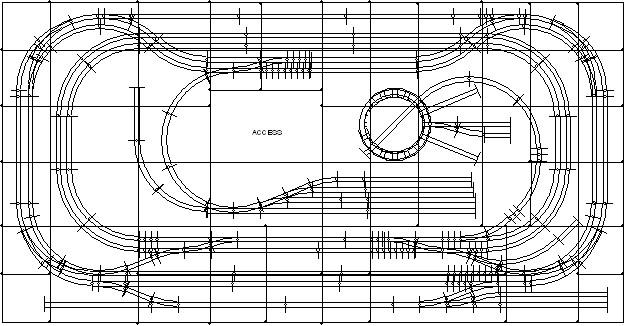
if the design works. The diagram below shows a standard Winrail drawing.

Winrail also contains track libraries for more specific scale
modelling as shown by the Marcway OO/EM plan shown below - larger plan available
on the link below.

View some of our Winrail layout plans.
We also happy to receive client drawn plans using Winrail or XTrkCAD (which is a freeware
product and includes the facility to run trains around the layout plan) to estimate for the construction of your baseboards or layout. The
following Winrail drawing was designed by a client and forwarded for
construction. The layout can be seen under construction in our Gallery.

We also manufacture layouts based upon commercial track
plan books produced by companies such as Hornby, Peco, Fleischmann, Marklin and
Kalmbach. We are also happy to alter commercial plans to fit your space and
general requirements where possible.

We often receive copies of magazine articles featuring a layout
that interests a client. We will check or alter these designs to fit your
available space where possible.
Layout planning should focus on track design, but consideration should be
given to the design of baseboards and scenery.
Click here for more details of layout design in our
baseboards section.
Professional Layout Services offer a full design
services using CAD packages. Design costs from £25-00 for a simple layout,
increasing with the time taken to design larger and more complex layouts. Design
work can be extended to include baseboards and wiring for an additional fee. If
you require an estimate for layout design, please send some basic details of the
following:
| Dimensions.
Draw a rough sketch of the layout room and state the width and length in
inches (preferably not feet and inches) or metric. Mark on the plan the
location of all doors, windows and radiators stating their distance from one
wall. With doors state how wide they are and which way they open; and in
addition with windows, state the height from the floor to the base of the
frame and if any timber protrudes into the room. Radiators pose a problem in that space above should be given to allow
the circulation of heat and reduce the chance of the baseboards warping. Mark
how far into the room radiators and any other obstructions e.g. chimney
breasts protrude. If you are in a loft only supply the usable area at the
height required, marking on any obstructions at this height. Try and give as much information as
possible and remember to consider access if the layout goes around the walls
of a room or in a loft if the 'hatch' is not into the middle of the
layout area. |
| Requirements.
It is very easy for us to design the layout plan that we would like to
construct in your room, but that is not the object of the exercise. In order
that we can focus our efforts into designing your layout, send a few details
of the type of layout you require, or even a rough sketch. A basic example
would be a twin track oval with large through station serving a branch line to
high level over a hidden fiddle yard. The station should have a passing loop,
bay platform on the up etc... We are also happy to receive copies of magazine
layouts if these offer a guide to your requirements. |
| Rolling Stock.
An important factor in the design of any model railway layout is the type of
stock to be used on the layout. The type of stock usually defines the minimum
track radius. If standard ready to run stock (Hornby, Lima etc.) is to be
used, the client has the option to use set track if space is limited, with a
minimum radius of approximately fifteen inches - however many of the new
commercial ready to run locomotives and some stock will only run on curves
at a minimum second radius (approx 17.5 inches). If kit built
locomotives are to be used, then a much increased minimum radius is required,
usually around three feet or more depending on the kit and builder. |
| Track Type.
Track type is again determined by the type of stock together with the age of
the stock, and the type of layout required. Four basic track types are
available as follows:
|
- Set Track. Set track uses
pre-formed track sections for straights and curves available in gauges Z
to G. All track sections are produced to a specific geometry based upon
the manufacturer selected. The most popular types include Peco, Hornby,
Fleischmann and Marklin with LGB in G scale. Set track is ideal for layouts where space is
restricted and standard ready to run stock is to be used. It is however
not suitable for use with kit built locomotives and some ready to run
stock does not perform on the inside radius. Stock of most ages is
suitable except for the very early stock where wheel flanges may be very
deep. The standard rail profile for most UK set track is code 100 for 00
gauge, and code 83 for N gauge.
- Flexible Track - Universal.
Usually manufactured from code 100 rail in 00 gauge, and code 83 rail in N
gauge, flexible track shares the benefits of set track in that it is
suitable for most ready to run models. It is however more realistic than
setrack as the normal minimum radius for bending flexible track is twenty
four inches in 00 gauge, and twelve inches in N gauge. This allows more
realistic appearing track as due to the reduced radius, the track can be
set at the standard six foot spacing between tracks, unlike set track
which has to be set wider to allow trains to pass in the sharp corners.
The track spacing is set when turnouts are combined to form a crossover.
The most popular ranges of flexible track include Peco. Generally more
turnout types are available allowing for more realistic track formations.
Flexible track can however be used in conjunction with the same code set
track.
- Flexible Track - Finescale.
Finescale track is the result of enthusiasts demanding a more realistic
rail profile as wheel standards have improved. Finescale track is
generally suitable for kit built models and most modern ready to run
stock, but is troublesome with older stock. The rail profile is reduced by
Peco to code 55 in N gauge, and code 75 in 00 gauge. Peco manufacture a
similar range of turnouts in code 75 and code 100. Peco have manufactured
code 83 for the American market.
- Hand Constructed Finescale Track.
Generally home made or produced from kits, hand constructed track is
usually made to specific gauges where scale is critical e.g. 2mm scale
(2mm to the foot scale option to N gauge), EM
gauge and S4/P4 (4mm to the foot scale options to OO gauge) the majority of stock running on this track is kit built or
re-wheeled ready to run, and S7 (7mm to the foot scale option for O
gauge). Exact track formations can be reproduced to
scale. Some manufacturers of components offer a construction service. For
layout design in the finer gauges we recommend Templot.
FOR MORE INFORMATION ON PLS LAYOUT DESIGN SERVICES
PLEASE CONTACT US.

|

